
Add Row
Add Element
cropper
update
Best New Finds
update
Add Element
  • Home
  • Categories
    • AI News
    • Tech Tools
    • Health AI
    • Robotics
    • Privacy
    • Business
    • Creative AI
    • AI ABC's
    • Future AI
    • AI Marketing
    • Society
    • AI Ethics
    • Security
August 28.2025
2 Minutes Read

Nvidia's Record Growth Signals Future Technology Trends in AI

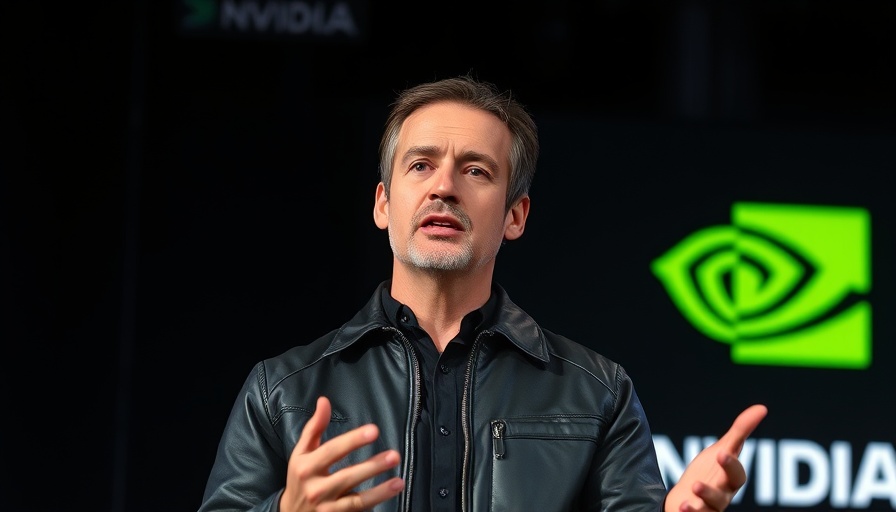
NVIDIA executive discusses AI-driven record sales at conference.

Nvidia's Record Sales Fueling AI Innovation

Nvidia has emerged as the beacon of success in the technology industry, reporting remarkable financial growth amidst the ongoing AI revolution. In its latest earnings statement, the company recorded an impressive $46.7 billion in revenue, marking a steep 56% increase year-over-year. This surge is predominantly driven by the burgeoning demand for AI solutions, showcased through a 56% jump in data center earnings, which totaled $41.1 billion. As industries increasingly rely on AI, Nvidia's advanced GPU technologies are poised to shape the future of computing.

Understanding the AI Market Dynamics

The AI sector is arguably the most transformative market today. As companies and governments invest heavily in technology, Nvidia has positioned its Blackwell chips at the forefront of innovation. NVIDIA's CEO, Jensen Huang, deems Blackwell the “AI platform the world has been waiting for,” signaling its expected role in shaping next-gen technologies. This aligns with recent trends where corporations, from startups to industry giants, are striving to integrate AI technologies into their operations, enhancing efficiency and productivity significantly.

Geopolitical Challenges Faced by Nvidia

Despite Nvidia's growth, geopolitical factors pose challenges to its expansion. The company reported no sales of its H20 chips in the crucial Chinese market during the last quarter. While U.S. regulatory constraints previously hampered its operations, recent modifications under President Trump allow for some sales—subject to a 15% export tax. Still, the Chinese government remains cautious about adopting Nvidia technology, which complicates its business strategy in the region.

AI's Revolution: Opportunities and Ethical Concerns

As tech enthusiasts, understanding Nvidia's trajectory isn't just about numbers; it's about the larger conversation surrounding AI ethics and its societal implications. The rapid deployment of AI technologies like those offered by Nvidia prompts essential questions about data privacy, AI governance, and the ethical use of automation. For example, as AI-powered tools permeate healthcare, one must consider how they impact patient data security and the potential for bias in AI decision-making frameworks.

Future Technology Trends Sparked by AI

Looking ahead, the interplay between Nvidia's advancements and AI developments is likely to set the stage for groundbreaking tech innovations. The integration of AI into various sectors—including healthcare, finance, and autonomous vehicles—suggests that the next big tech trends will revolve around AI's ability to create more efficient systems. This will not only redefine business operations but also enhance products and services across industries.

Conclusion: A Call to Innovate

Nvidia’s remarkable financial performance reflects a broader shift in technology towards AI-driven solutions. As emerging tech trends continue to evolve, it is crucial to stay informed and adaptive to these advances. Engaging with the latest in AI can equip students, young professionals, and enthusiasts not only to understand the current landscape but to thrive within it. To seize these opportunities in the tech world, explore various AI applications and tools, and prepare for the innovations of tomorrow.

AI News

1 Views

0 Comments

Write A Comment

*
*
Related Posts All Posts
01.16.2026

Leadership Shakeup at Thinking Machines Lab: What it Means for the Future of AI Technology

Update Talent Shift in AI: Understanding the Impact of Leadership ChangesThe landscape of artificial intelligence (AI) is ever-evolving, and few events highlight this shift as dramatically as the recent departures at Thinking Machines Lab. Co-founders Barret Zoph and Luke Metz, both veterans from OpenAI, are making a significant move back to OpenAI, just months after starting their new venture under the leadership of Mira Murati. Such transitions are notable in the fast-paced tech industry, but when they involve co-founders, the implications reach deep into the organization's fabric.What Led to This Wave of Departures?As Zoph and Metz return to their former employer, the circumstances surrounding their exit from Thinking Machines have sparked discussions about workplace culture and loyalty. Reports suggest that Zoph's departure may not have been entirely amicable, potentially involving allegations of sharing confidential information with competitors. This raises questions about the internal dynamics at Thinking Machines and the challenges emerging AI startups face while attempting to carve out their presence in a largely monopolized industry.Thinking Machines, co-founded with the ambition to push boundaries in AI technology, has already attracted significant investment, with a valuation of $12 billion following a fruitful seed round led by Andreessen Horowitz. Yet, losing key members like Zoph and Metz undermines the trust and stability that investors often require.The Broader Context of AI Talent MobilityThe trend of talent migration within the AI field, especially among former employees of powerhouse companies like OpenAI, is nothing new. The rapid evolution of technology often leads experts to seek new challenges and opportunities, creating a dynamic marketplace for skills. In many cases, those who leap from established entities to emerging startups broaden their horizons, bringing back invaluable experience upon returning. This is a common cycle in sectors where innovation and agility are highly valued.The Future of Thinking Machines Lab: A Road AheadMoving forward, Thinking Machines Lab has appointed Soumith Chintala as the new Chief Technology Officer (CTO). Chintala, with his extensive contributions to AI, particularly in the open-source community, aims to stabilize the team and guide the company towards its ambitious objectives. His success in this role will depend on both his vision and the ability to foster a cohesive team atmosphere post-departure.For readers interested in the future technology landscape, Keeping an eye on how startups adapt and overcome these types of challenges within the AI sector will be paramount. The competition is fierce, and those that can maintain a strong foundation despite organizational changes will likely be the next innovators driving disruptive technologies into the market.

01.13.2026

Can AI Finally React Like a Real Person During Video Calls?

Update Can AI Finally Mimic Human Reactions in Video Calls? Ever had a conversation where the other person seems to be just a talking head? As AI technology advances, video calls often feature lifelike avatars that can replicate facial movements, but they still fall short in fundamental areas—most notably, in their ability to react like a human. The real essence of conversation lies in dynamic interaction; when we talk to someone, we expect them to nod, smile, or even furrow their brows in response. Current AI models, however, often freeze, providing a disappointing illusion of engagement. The Latency Dilemma The challenge with many existing avatars is their architecture. Take the INFP model, for instance, which processes conversation contexts but requires a significant temporal window—often over 500 milliseconds—to generate a reaction. Unfortunately, humans expect feedback much quicker, ideally within 200-300 milliseconds. This latency disrupts the flow of conversation, making interactions feel less personal and more like a monologue. Consequently, we are left wondering whether our conversational partner is genuinely attentive. Expressiveness: The Missing Link When AI does respond, it’s often with a blandness that fails to convey genuine emotion. For example, an avatar that reacts to good news should express delight, yet many only display mild micro-movements. This lack of expressiveness points to a key issue: without extensive training on what constitutes effective emotional reactions, these AI systems resort to timid responses that hardly resemble human reactions. Collecting vast datasets to teach AI what different responses look like poses both logistical and financial challenges. Rethinking AI Architecture Research suggests that a fundamental shift in AI architecture is necessary to address these limitations. The need for real-time interaction without dependencies on full-context understanding is crucial. For instance, fresh models like Microsoft's StreamMind could revolutionize the way AI reacts by mirroring human thought processes—responding to significant events without sifting through every single piece of data. This innovation could lead to swifter, more human-like interaction. The Future of AI in Communication AI technology is on the brink of a transformation that may redefine how we perceive virtual interactions. With advancements in machine learning and emotion detection, future systems could facilitate richer, emotionally resonant communication through avatars that listen and respond authentically. The next decade is set to usher in an era where online meetings feel more intuitive, bridging the gap between digital and face-to-face interactions. Conclusion: Embracing the Shift in Communication As AI continues to evolve, the potential to enhance communication through more responsive avatars is immense. Embracing these advancements will not only improve our virtual interactions but also help us develop a deeper connection, even from a distance. Are you ready to explore how these developments might change the way you communicate?

01.10.2026

Discover Chatterbox-Turbo: The Next Step in AI Voice Technology

Update This Month’s Star: Chatterbox-Turbo Unveiled In the ever-evolving world of text-to-speech technology, the Chatterbox-Turbo has made a striking debut. Boasting a remarkable 350M parameters, this latest model from Resemble AI focuses on swift, efficient performance while ensuring top-notch audio quality. This engineering marvel is not just another entry in the chatterbox family—it is a game-changer, perfect for applications that demand low-latency voice synthesis. How Chatterbox-Turbo Stands Out Chatterbox-Turbo enhances user experience by reducing the computational demands typically associated with high-quality audio generation. One standout feature is its distilled speech-token-to-mel decoder, which simplifies the synthesis process from 10 generation steps to a single step. This efficiency is crucial for developers aiming to build responsive voice agents and applications. Creating Authentic Interactions with AI What sets Chatterbox-Turbo apart is its ability to accept paralinguistic tags in the input text, enabling a seamless integration of vocal expressions—like [cough] and [laugh]—directly into the audio output. Such capabilities are invaluable for producing more relatable and engaging dialogues in conversational AI, audio narrations, and customer service applications. As users experiment with different inputs, they can see the impact of mood and tone on user experience. Practical Applications This model caters to diverse creative and practical needs: whether it’s crafting immersive audiobooks, enhancing multimedia content, or providing responsive customer service, the potential applications are vast. Organizations can leverage Chatterbox-Turbo for high-volume audio production without the usual compromises in quality or speed. Additionally, features like voice cloning through a brief audio sample bring exciting possibilities to content creators and game developers. Why Understanding AI is Essential in Today’s Tech Landscape As we venture further into 2026, the relevance of AI technologies grows exponentially. Models like Chatterbox-Turbo underscore the significance of understanding core AI concepts, from deep learning basics to machine learning techniques. For those seeking to navigate this landscape, embracing resources such as beginner's guides to AI and tutorials is key. The advent of generative AI tools highlights a notable shift towards enhancing creativity across industries, making AI education critical for newcomers. As individuals and organizations embark on their AI journeys, being well-acquainted with the principles and applications of this technology will empower them to harness its full potential—opening doors to innovations that redefine industries. Stay informed, explore AI’s capabilities, and consider how technology like Chatterbox-Turbo can impact your projects or business strategies.

Terms of Service

Privacy Policy

Core Modal Title

Sorry, no results found

You Might Find These Articles Interesting

T
Please Check Your Email
We Will Be Following Up Shortly
*
*
*

